Character Bible Template for Production: Wardrobe, Continuity, and Physicality
Search "character bible template" and you'll get backstory prompts for novelists: childhood wounds, secret fears, favorite color. None of that helps a costumer pull a fitting or a production designer age a set dressing to match. This is the other character bible — the one built for what a camera actually has to reproduce, scene after scene, without anyone noticing it changed.
Introduction: Two Different Documents Share a Name
"Character bible" means something specific in the writing world: a running document of a character's history, motivations, and voice, kept so a novelist or showrunner stays consistent across hundreds of pages of prose. That's a real and useful document. It is also almost entirely useless to the people who have to physically produce a scene — the costumer fitting an actor, the production designer choosing a set dressing era, the hair and makeup department deciding whether a character's look changes between two scenes shot four months apart.
Those departments don't need to know a character's secret fear. They need to know what the camera will see — age range, build, what they're wearing in each scene, whether an injury or a wardrobe change needs to persist across a cut, and exactly which script pages establish each of those facts. That's a different document, and it deserves a different template, because the writing-craft version genuinely won't help you here.
- The specific fields a production character bible needs that a writing-craft template doesn't have
- How to read a script for physical fact instead of personality
- Why continuity tracking across scenes is the whole point, not an afterthought
- How this document hands off cleanly to costume, design, and storyboard staging
This builds directly on the extraction discipline in character and location breakdown. That piece gets you a clean, canonical list of who's in the story. This one is about what goes into each entry once you have it — for a visual production, not a novel.
What Belongs in a Production Character Bible
A costumer, a production designer, and a first AD are all reading this document for the same reason: to reproduce the same person, consistently, across a shoot schedule that will not run in script order. Here's what actually earns a field.
Age Range and Build
Whatever the script states or implies — "30s, tired eyes," "heavyset, late 50s." This drives casting and, downstream, every costume and prop choice sized to a body.
Why: A costumer fitting the wrong build wastes a fitting session; a designer aging a hand prop wrong breaks the read of a shot entirely.
Wardrobe, Scene by Scene
What the character is wearing at first appearance, and every point after where the script explicitly changes it — a torn jacket, a change of clothes after a time jump, a uniform that comes off mid-scene.
Why: This is the single most common continuity failure on a set shot out of order — nobody remembers which jacket was torn until the editor finds the mismatch.
Physical Marks and Changes
An injury sustained mid-script, a haircut, a pregnancy, anything the story requires the audience to see change and then hold consistent afterward.
Why: These need a plan — makeup continuity sheets, a shooting order that respects the change — decided before the schedule locks, not discovered on set.
Distinguishing Props Worn or Carried
A watch, a wedding ring, glasses, a weapon — anything attached to the character rather than the set, which needs its own continuity across every scene it appears in.
Why: Props departments track objects; this field is what tells them an object belongs to a person's continuity, not just a scene's.
Source Lines for Every Fact
The exact page and line that established the age, the build, the wardrobe change — not a description written from memory of the read-through.
Why: When a costumer or designer questions a call, "the script says so, right here" ends the conversation faster than an argument from recollection.
Backstory, motivation, internal arc, voice — all genuinely useful to a writer or an actor building a performance, and all irrelevant to whether the costume department gets the jacket right in scene 40. Keep those in the writers' room document. This bible has one job: physical, visual continuity that a camera will record.
Reading a Script for Physical Fact, Not Personality
The habit this requires is different from a normal script read, and it's worth naming directly: you're reading for nouns and adjectives attached to a body, not for what a character wants. A line like MARCUS (40s, suited) sits alone, papers spread in front of him gives you age, build implication, and a wardrobe fact in one sentence — and most first reads absorb none of it as data, because the sentence is doing narrative work at the same time.
scene_22.fountain
  1   INT. MARCUS'S OFFICE - DAY
  2
  3   MARCUS (40s, suited, a bandage on his left
  4   hand he keeps hidden in his pocket) reviews
  5   a file. His tie is loosened, sleeves rolled.
Three physical facts in one description: age and build, a wardrobe state ("tie loosened, sleeves rolled" — casual, mid-day), and a continuity item that needs to be tracked forward (the bandage, and the fact that he's actively hiding it). Miss the bandage on a first read and it's the kind of detail that resurfaces as a continuity error three shoot days later, when the hand appears unbandaged in a scene that comes after this one in the story but was shot first.
This is exactly the kind of detail that action lines bury in plain sight — nothing about it is hidden, it's just competing with everything else the prose is doing. The fix isn't reading more carefully out of willpower. It's running a dedicated pass whose only job is physical fact, the same way character and location breakdown argues for a dedicated pass before shot planning starts.
Why This Has to Track Across Scenes, Not Just Exist Once
A character bible that describes Marcus once, at his first appearance, and stops isn't a continuity tool — it's a casting note. The value of this document comes entirely from tracking how each fact changes, or explicitly doesn't change, across every scene the character appears in, because that's the exact information a shooting schedule out of script order will otherwise scramble.
The Failure Mode This Prevents
Shoots rarely film in script order — locations, actor availability, and light dictate the order instead. If Marcus's bandaged hand appears in scene 22 and heals by scene 40, but the schedule shoots scene 40 before scene 22, someone needs to know, in advance, that the hand must be dressed with a fading bruise rather than bare skin on the earlier shoot day. That's not a creative call anyone makes on the day — it's a fact the bible should have surfaced during scheduling.
This is the same underlying problem covered in continuity tracking across scenes, applied specifically to the character's body and wardrobe rather than props or set dressing generally. If you're building both documents, they should share the same source-line discipline and the same canonical character identities established in your breakdown pass — a wardrobe fact tied to "Reyes" and one tied to "Detective Reyes" needs to resolve to the same person before either document is trustworthy.
Handing It to Costume, Design, and Storyboard
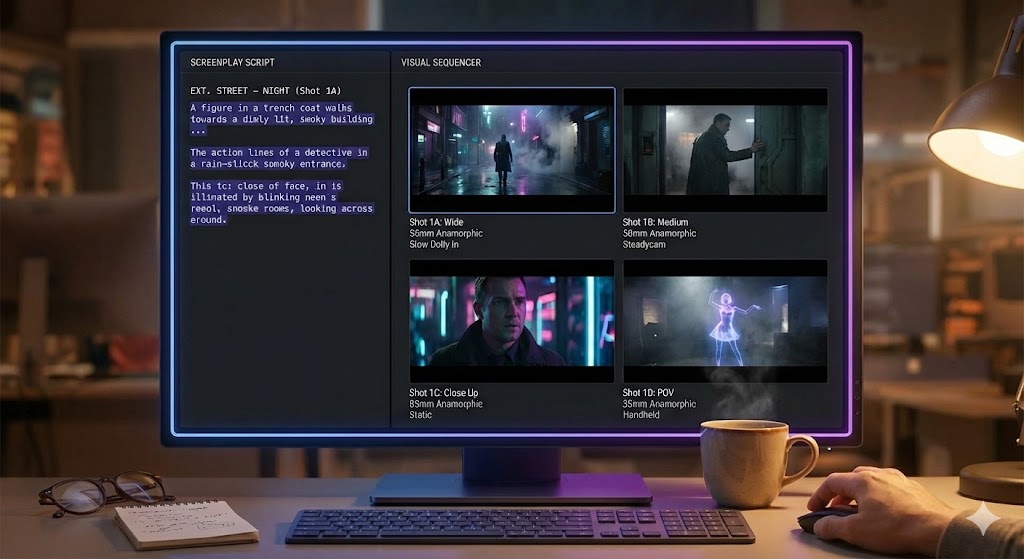
A production character bible earns its keep at the exact moment three different departments need to agree on what a character looks like without being in the same room. A costumer fitting for scene 40 needs to know the bandage is gone. A production designer choosing set dressing in Marcus's office needs to know his desk stays cluttered from scene 22 onward per the same description. A storyboard artist — or an AI storyboard prototype — staging that scene needs the same wardrobe and physicality facts to keep the character visually consistent frame to frame.
Keeping a character visually consistent across dozens of generated frames is one of the harder problems in AI storyboarding today — we cover the specific failure modes and what actually helps in character-consistent storyboards. A clean character bible, with wardrobe and physicality nailed down per scene, is the input that makes that problem tractable instead of guesswork.
None of this requires exotic tooling — a shared spreadsheet or document works, as long as every fact carries its source line and every character identity has already been resolved through the aliasing pass described in character and location breakdown. What matters is that the document exists as its own deliverable, checked against the script, rather than living only in the memory of whoever attended the read-through.
The Bible Nobody Notices Working
A production character bible succeeds invisibly. When it works, nobody notices — the jacket matches, the bandage is in the right scenes, the audience never registers a continuity break because there wasn't one. When it's missing, everybody notices, usually in the edit, usually too late to reshoot cheaply. That asymmetry is exactly why it's worth building deliberately instead of relying on whoever remembers the read-through best.
Build it for what the camera needs to reproduce, not what a novelist needs to imagine. The writing-craft template was never going to help your costumer — this one is built for the job you actually have.
Extract Character Facts Straight From the Script
ShotList.Studio's Characters stage pulls physical description, wardrobe, and continuity facts as structured fields with source lines attached — a production bible you can check against the page, not just trust.
See the tool