Will AI Replace Storyboard Artists?
We build an AI tool that draws storyboard frames from a script. We are also the people most exposed if the honest answer to this question were "yes." It isn't. Here's why, argued as carefully as we can manage.
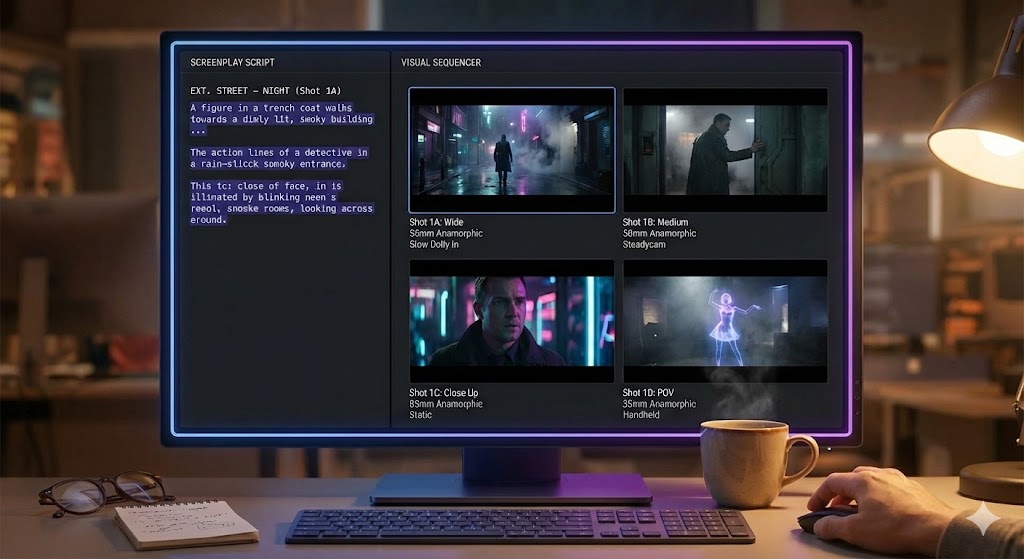
The Question Everyone Actually Wants Answered
People don't ask us this question out of idle curiosity. They ask it because they're a storyboard artist watching a software company sell a tool that draws the thing they draw, or a director wondering whether they still need to budget for one, or a film student trying to decide what to spend the next four years learning. It's a livelihood question wearing a technology question's clothes, and it deserves a straight answer rather than a marketing one.
So here is ours, stated plainly before we argue for it: no, AI will not replace storyboard artists. Not as a hope, not as a hedge, not as a "not yet." We think the case holds up even from inside a company whose entire product is an AI that generates storyboard frames — maybe especially from inside that company, because we're the ones who have spent the most hours watching exactly where the software is useful and exactly where it stalls out.
That distinction — between where it's useful and where it stalls — is the actual subject of this piece. The lazy version of this debate treats "AI" as one thing that either does or doesn't threaten "artists" as one thing. Neither side of that framing survives contact with an actual production. The honest version requires being specific about which part of the job is being discussed, because storyboarding is not one task. It's several, bundled under one job title, and they have very different relationships to automation.
What AI Actually Replaces: The Tedious First Pass
Start with what a script-to-storyboard tool is actually good at, because pretending it's useless would be its own kind of dishonesty, and this essay only works if it's honest in both directions.
Before a single frame gets drawn on most projects that can't afford a full-time board artist for every meeting, someone has to do a rough pass: read the scene, guess at coverage, sketch a stick-figure sense of blocking just so the director and the DP are looking at the same rough shape of a scene instead of describing it to each other in words. This pass is not art. Nobody frames it, nobody signs it, nobody looks back on it with pride. It exists to be superseded. It is, by design, thrown away the moment it has done its job of getting a room to agree on what they're talking about.
That is the layer AI is actually good at, and it's a bigger layer than people assume. A model that has read enough screenplays and enough coverage patterns can take a scene — a slugline, an action block, a scrap of dialogue — and produce a plausible first guess at shot size, angle, and rough staging in the time it takes to read the scene once. It won't be inspired. It doesn't need to be. Its job is to stand in for the version of this work that used to eat an afternoon and produce nothing anyone wanted to keep.
Why this was never really "artist's work" to begin with
It's worth naming why this displacement doesn't cost what it sounds like it costs. The rough first pass was rarely commissioned as art in the first place — it was commissioned as communication, a scaffold to get a director's mental picture out of their head and onto a surface everyone else could react to. Low-budget productions frequently skipped it entirely, because paying a working artist's day rate for something that gets discarded by lunch was never a sane use of a small budget. The alternative to "AI does this" was usually not "an artist does this" — it was "nobody does this, and the crew finds out what the director meant on set."
The Prototype Nobody Was Paying For
Push this one step further, because it's the crux of the economic argument and it's easy to gloss over. There is a category of visual work in pre-production that exists purely to be argued with — not to survive into the film, not to be shown to an audience, not even necessarily to be shown to the studio. It's the version you generate at 11pm to check whether a coverage idea actually reads before you burn a morning of a real artist's time finding out it doesn't.
That category was, in practice, mostly unpaid work anyway. It was the director's own bad marker sketches. It was a script supervisor's shorthand. It was nothing, because there wasn't time or budget for it to be anything, and the scene got shot on instinct instead. When a tool generates that pass automatically, it isn't taking a commission away from an artist. It's filling a gap that mostly went unfilled — or was filled badly, by someone with no training in staging, under deadline pressure, because the alternative was worse. That's the honest shape of the displacement: not artist to machine, but absence to something-better-than-absence.
This reasoning stops working the moment someone tries to stretch it past the throwaway layer — using generated frames as the final pitch deck art, the poster comp, the thing an investor or a studio actually judges the film by. At that point you're not automating an unpaid scramble anymore. You're substituting for commissioned work, and the argument for AI doing it collapses, because now it has to be good in a way it structurally isn't.
What AI Cannot Do
Here is where the honest version of this essay has to stop hedging and get specific, because "taste" and "vision" get thrown around in these debates as if naming them settles anything. They don't, on their own, mean much. What they cash out to, on an actual set or in an actual pitch meeting, is three concrete capacities a model doesn't have.
The read of a room
A working storyboard artist in a pre-production meeting is not just drawing what's described. They're watching the director's face when they describe it, noticing the beat where the words say one thing and the hand gestures say another, and drawing the gesture. They're catching that the producer just flinched at a shot that implies a crane the budget can't support, and quietly proposing an alternative before anyone has to say the word "no" out loud. That reading — of a specific group of specific people, in a specific room, with a specific budget hanging over the conversation — has no input field. It isn't a prompt you're forgetting to write better. It's a live human read of other live humans, and it's frequently the actual value being paid for, more than the pencil marks.
Knowing which rule to break
Coverage has conventions for good reasons — the 180-degree line, eyeline matches, the grammar of a shot-reverse-shot — and a model trained on enough footage will reproduce them faithfully. But faithfully is exactly the problem. Every experienced cinematographer and production designer can tell you about the shot that only worked because someone broke a rule they understood perfectly, at the one moment breaking it served the story instead of confusing the audience. That judgment call — this scene, this beat, this specific violation, for this specific reason — is downstream of understanding why the rule exists, not just what it looks like when followed. A system trained to predict plausible coverage will regress toward the convention. It has no mechanism for knowing when the convention is the wrong choice, because it has no stake in the story being told.
Taste that survives disagreement
Last, and hardest to name cleanly: a real artist's taste holds up under an argument. A director can push back on a board — "I don't buy this, try it uglier, try it more static, try it wrong on purpose" — and a good artist can defend a choice, adapt it, or abandon it with reasons attached, because the choice came from somewhere. It was reasoned, even if intuitively. Generated output doesn't have that underneath it. Push back on it and you get a different guess, not a defended position. That difference matters enormously in a collaborative medium where half the value of a storyboard session is the argument it starts, not the image it ends with.
Where the Line Falls on a Real Production
Put together, the practical line looks roughly like this. Early-stage, high-volume, low-stakes visualization — the pass that gets a scattered team looking at the same rough shape of a scene before the expensive decisions get made — is fair territory for a tool, and treating it as sacred artist's work mostly protected a task nobody enjoyed and few could afford. The moment a board has to carry weight — pitching investors, briefing a stunt coordinator, locking a set build, standing in for a shot the schedule can't afford to get wrong on the day — that's an artist's job, and it should stay one. Not as a courtesy. Because the tool genuinely cannot do it as well, for the reasons above.
We've built our product around that line rather than around pretending it doesn't exist. The frames a script-to-storyboard tool generates are meant to be argued with, edited, thrown out, and eventually handed to a human artist once the ideas they were testing are worth paying to render properly. That's not a modest claim made for marketing reasons. It's the actual shape of what the software is for.
In This Series
This is the first entry in an ongoing look at where AI genuinely belongs in pre-production and where it doesn't. Published so far:
- The Source Line Problem — why most shot lists can't tell you why a shot exists, and what it takes to fix that, with or without software.
- Coming soon: what a director's "read" of a scene actually requires, and why it resists being specified in a prompt.
- Coming soon: a closer look at the economics of the throwaway prototype, and who was actually paying for it before.
The Honest Answer
No. Not as a slogan we put on the About page because it tests well, but because we don't see a mechanism by which it becomes true. AI can absorb the part of storyboarding that was always closer to clerical labor than to craft — the rough first pass, the scaffold nobody wanted to pay a real rate for. It cannot absorb the part that depends on reading a specific room, knowing which convention this specific story needs broken, or holding a position under an argument. Those aren't gaps in the current generation of models that a bigger one closes. They're differences in kind.
If you're a storyboard artist reading this wondering whether to be reassured: be specific about which half of your work this is describing, and keep building the half a model can't touch. If you're a filmmaker wondering whether you still need one: for anything that has to carry a real decision, yes, you do.
If you want to test this on your own script
Read a scene with our tool, see what a first-pass storyboard actually looks like, and judge for yourself where it's useful and where you'd rather have a hired artist in the room. That's the whole pitch — no more, no less.