The Source Line Problem
Six weeks after the breakdown, someone asks why shot 14 is a low angle. Nobody in the room remembers. Most shot lists have no way to answer that question — and that's a discipline problem, not a software problem.
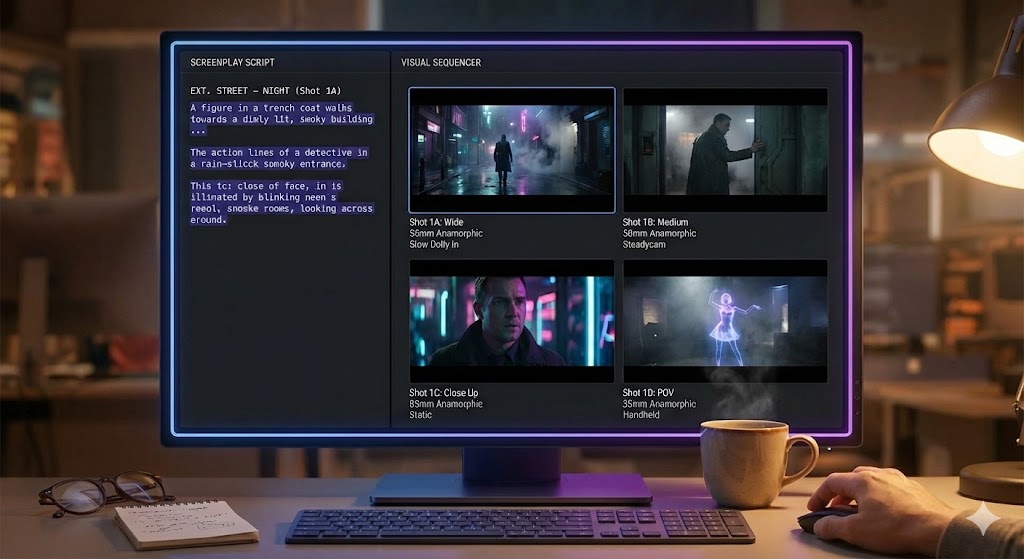
Six Weeks Later, Nobody Remembers
Here's a scene that plays out on more productions than anyone likes to admit. It's week five of post, or it's a reshoot day, or it's a note session with a producer who's seeing the cut for the first time. Someone points at shot 14 and asks: why is this a low angle? What was that supposed to be doing?
Silence. The 1st AD who lined the script has moved to another job. The director half-remembers a reason but isn't sure if they're reconstructing it after the fact. The shot list itself says "14. LOW ANGLE. Marcus. Static." — accurate, and completely useless for answering the question actually being asked. The shot list recorded what was decided. It didn't record why.
That gap is the subject of this piece: not a tooling gripe, but a discipline most shot lists don't practice, on paper or on a laptop. And to be clear about what kind of argument this is — we're not claiming software should be the one making these calls for you. We've made the case against that elsewhere. This is an argument that whoever does make the call should be able to explain it later, to someone who wasn't in the room.
What Most Shot Lists Can't Tell You
A conventional shot list is a list of decisions, stripped of the reasoning that produced them. Shot number, size, angle, movement, lens, maybe a one-line description. It's built to be read on set, fast, by a crew that needs to know what to set up next — and for that job, it works. What it isn't built for is being read six weeks later by someone asking whether the decision still makes sense, or ever did.
This is a bigger problem than nostalgia for a forgotten rationale. A shot list without justification can't be audited. When a schedule gets cut and something has to go, nobody can tell which shots are load-bearing for the story and which were coverage for coverage's sake. When a reshoot changes a line of dialogue, nobody can quickly see which existing shots that line was driving, and which are now shooting nothing in particular. When a new AD or a new editor joins mid-production, they inherit a list of outputs with no visibility into the input that generated them. Everyone downstream is stuck reverse-engineering intent from a spreadsheet cell.
We think of this as roughly the same problem showrunners solved decades ago with continuity notes and the same problem lawyers solve with citations: a record that only shows conclusions is much less useful than one that shows conclusions and their basis, because the basis is what lets someone else evaluate, defend, or revise the conclusion later.
The Source Line: Traceability as Discipline
We call this idea the source line — the specific line or beat in the script that a given shot exists to serve. Not the scene. The line. "She spots Marcus at the corner table" is a source line. "Their eyes meet" is a different one. A shot list with source lines attached doesn't just say shot 14 is a low angle — it says shot 14 is a low angle because line 11 needs Marcus to feel like he's being watched from a position of disadvantage. Now the question from the post session has an answer that doesn't depend on anyone's memory.
This matters independent of whatever software you use to build the list, which is worth saying plainly given who's writing this. A tool can prompt you to record a source line next to every shot. It cannot make the underlying discipline exist in a production that doesn't already practice it. That discipline is the actual asset. The software is just a place to keep it from getting lost.
Pick any shot on your current list at random and ask: which line of the script is this shot for? If you can't answer in one sentence, you don't have a justification for that shot — you have a guess that's calcified into a line item.
Building the Habit, Tool or No Tool
You don't need any particular piece of software to start doing this. It's a habit you can build with a highlighter and a spreadsheet column.
Add one column
Next to shot number and shot type, add "source line" — the exact line or beat from the script driving this shot. If you can't fill it in immediately, that's information too.
Fill it in during breakdown, not after
The reasoning is freshest at the moment you decide the shot. Reconstructing it later is exactly the failure mode this whole piece is about.
Make "no source line" a red flag
A shot with no line to point to isn't automatically wrong, but it should get a second look. It might be pure style — which is fine, if it's a deliberate choice and not an accident of habit.
Review it before the schedule gets cut
When a shooting day gets shorter, the source line column is what tells you which shots are protecting story beats and which were nice-to-haves.
Where the Habit Actually Pays Off
The value shows up exactly at the moments a shot list is normally weakest: under pressure, months after the breakdown, in front of people who weren't in the original room. A producer questioning coverage, a new editor trying to understand why the footage looks the way it does, a 2nd unit picking up shots the original AD isn't around to explain — all of these get faster and less political when the justification travels with the shot instead of living only in someone's memory.
It also changes how a list gets built in the first place. Once you know you'll have to write down a reason, you stop generating shots reflexively — one more angle because it seemed prudent — and start generating them because a specific moment in the script asked for them. That's a quieter benefit than the audit trail, but it's arguably the bigger one: a shot list that has to justify itself ends up shorter, and the shots that remain earn their place.
Make It a Rule, Not a Feature
None of this requires waiting for anyone to build you a product. It requires deciding, on your next breakdown, that no shot gets added to the list without a one-sentence answer to "which line is this for." That's the whole discipline. Everything else — software that stores it, formats it, or surfaces it automatically — is convenience layered on top of a habit that has to exist regardless.
We happen to build a tool that treats the source line as a first-class part of every shot, because we think a shot list that can't justify itself isn't finished. But the habit predates the product, and it'll outlast whatever tool you use to practice it.
See it built in
In ShotList.Studio, every generated shot carries its source line by default, so the justification never has to be reconstructed later. Read a scene and see what that looks like on your own script.