What an AI Storyboard Generator Is Actually Good For
Not the final art. Not a replacement for an artist. An AI storyboard generator's real job is narrower and more useful than the marketing suggests: it wins the argument before you've spent real production money.
The Wrong Question to Ask
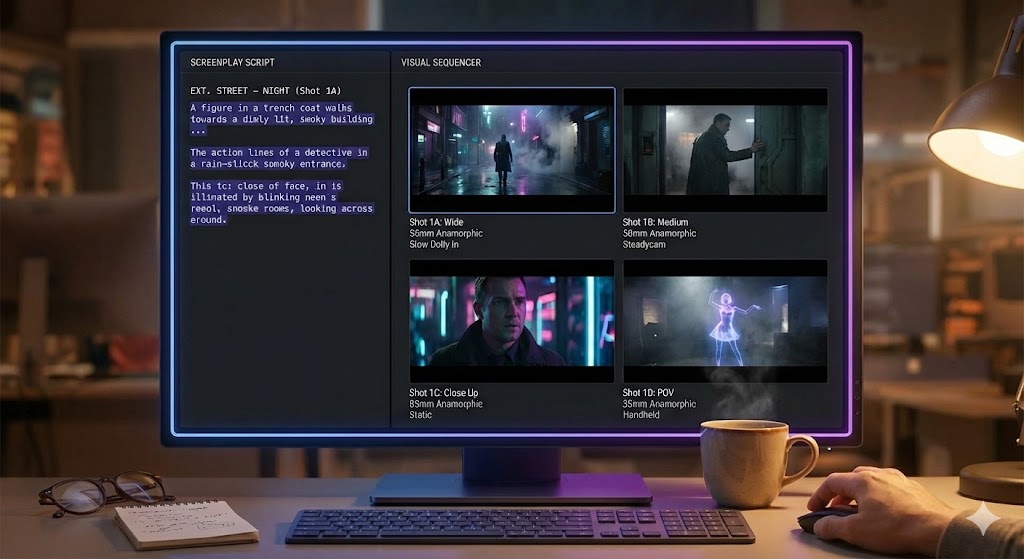
Most coverage of AI storyboard tools asks "is the art good enough?" — and then argues about hands, faces, and whether a frame looks like it came from a human illustrator. That's a fair question if you think the output is supposed to be a finished storyboard. It isn't, and treating it like one is where people get burned.
We laid out the fuller argument in the honest ladder for directors who can't draw: stick figures, description sheets, AI prototypes, and a hired artist are four different tools priced at different levels of speed and fidelity, not four quality tiers of the same thing. An AI storyboard generator sits at rung three of that ladder for a reason. It's fast and cheap, and it trades away precision to get there.
Not "is this good art?" but "does this get the right people agreeing on the scene fast enough to matter?" Judged by that standard, AI storyboards clear the bar constantly — and fail it in specific, predictable ways worth knowing in advance.
What They're Actually For: Winning the Argument Before You Spend Money
Every production has a handful of moments where a decision needs a picture, not a description, and needs it before anyone commits budget. Does the blocking work in this location, or is it too tight for three actors and a dolly? Will the investor understand what a "cold open in the rain, wide, then punch to a CU" actually looks like, or are you asking them to fund your imagination? Does this creature or effects beat read the way the script implies, before you brief a VFX vendor on day-rate hours?
An AI storyboard generator answers those questions in minutes instead of days. That's the entire value proposition, and it's a real one — it doesn't need to be more than that to be worth using.
Where They Genuinely Help
Pitching a Scene
Producers and investors react to images faster than they react to a page of shot descriptions. A rough frame ends the guessing.
Testing Blocking
See whether your planned staging actually fits the geometry of a location before you're standing in it on the day.
Aligning a Crew Fast
A DP, gaffer, and production designer looking at the same rough frame settle disagreements that a verbal description drags out.
Iterating Cheaply
Regenerating a frame after a tweak costs a few minutes, not a callback to an illustrator's schedule.
Notice what all four have in common: they're conversations, not deliverables. The frame exists to get a decision made, and once the decision is made, the frame has done its job — whether or not it survives contact with the actual shoot day.
Where They Fall Down
This is the section most AI storyboard marketing skips, and it's the reason this post exists. If you're going to use these tools well, you need to know exactly where they stop being reliable.
Character Consistency Across Frames
Ask for the same character in shot 3 and shot 7 of a sequence and there's no guarantee the generator renders them identically — hair, wardrobe, and build can drift between frames. For a single establishing image this doesn't matter. For a multi-shot sequence meant to represent continuous action, it can actively mislead a crew about what's continuous and what isn't.
Precise Geometric Blocking
A storyboard sometimes needs to be exact — the character is two feet from the door, the eyeline crosses at this specific point, the foreground object occludes exactly this much of the background. AI generation is good at plausible composition and inconsistent at that level of geometric precision. If the blocking argument depends on exact spatial relationships, verify it against the real location, not the frame.
Faces, Hands, and Fine Detail Under Scrutiny
This is the well-known failure mode, and it hasn't fully disappeared. For a wide or medium shot used to communicate staging, it rarely matters. For a close-up meant to sell a specific expression or gesture, treat the output as a placeholder for the beat, not a reference for the performance.
Art Direction and Genre-Specific Visual Language
A generator trained on broad visual patterns doesn't know your film's specific look — the production designer's palette, the specific creature design, the exact period detail a costume department has been researching for weeks. It gives you a generic version of "a scene like this," which is exactly why it's a prototype and not a design document.
Anywhere a board needs to be trusted without a human checking it against the real plan — VFX bidding, stunt safety, a build a construction crew works from — an AI draft is the wrong tool. That's a job for a professional artist, not a prompt.
How to Use One Without Fooling Yourself
The failure mode isn't using AI storyboards — it's forgetting they're drafts. A few habits keep the tool in its useful lane:
- Generate from a real shot list, not a vague prompt. The clearer your shot size, angle, and blocking notes going in, the more useful the frame coming out — this is the same discipline covered in why the shot list comes before the storyboard.
- Treat every frame as a redraw candidate. If something reads wrong, tweak and regenerate rather than accepting a close-enough frame — the cost of iteration is the whole point of using AI here.
- Verify anything load-bearing against reality. Exact blocking distances, eyelines, and safety-critical staging get checked at the actual location, not trusted from the drawing.
- Know your exit point. The moment a board needs to survive scrutiny from a vendor, stunt team, or construction crew, that's your cue to hire the artist, not push the prompt further.
The Honest Verdict
An AI storyboard generator is a genuinely useful tool for a genuinely narrow job: getting a room to agree on a scene, fast, before anyone spends money finding out they disagreed. It is not a storyboard artist, it doesn't claim to replace one, and the moment a board needs to carry real production weight — safety, VFX bidding, a construction build — the honest move is to hand it to a professional. Used inside that boundary, it's one of the more useful additions to pre-production in years. Used outside it, it's a fast way to make a confidently wrong decision.
Turn Your Shot List Into a Draft, Fast
ShotList.Studio generates storyboard frames straight from your shot list — the fast rung, used the way it's meant to be used.
See the tool